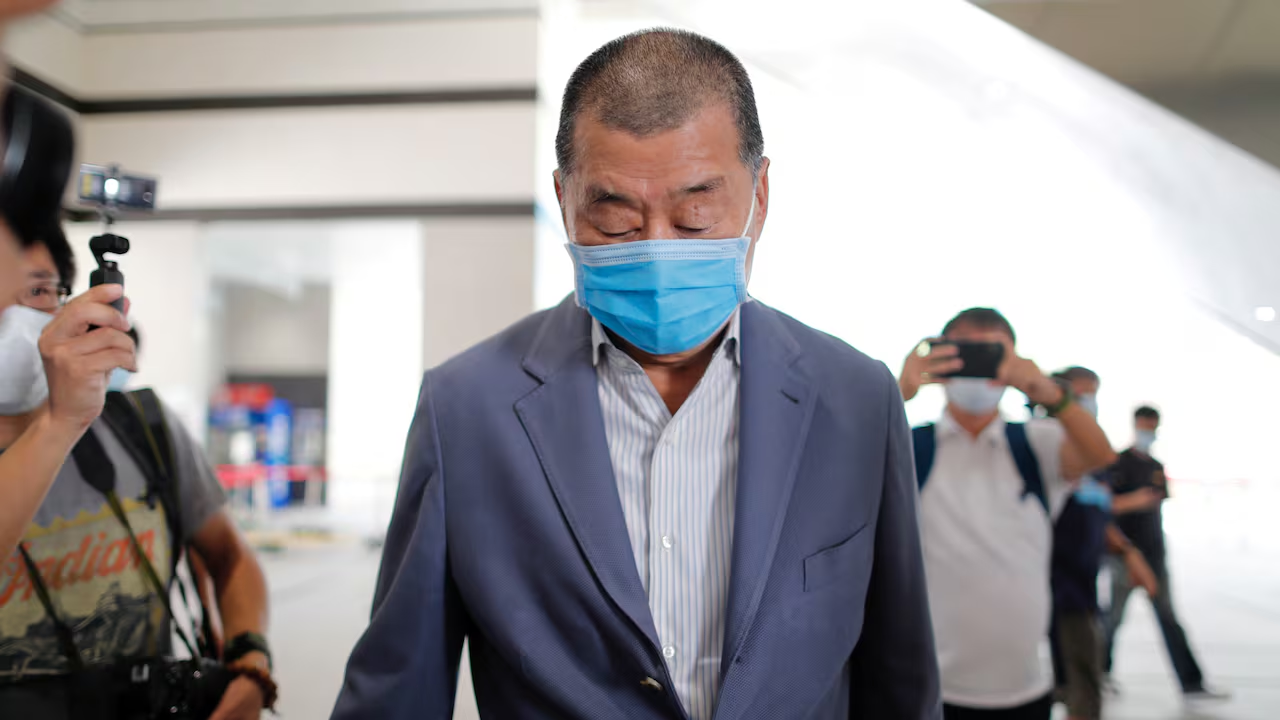
In a development that has sent shockwaves through international human rights circles, Hong Kong democracy advocate Jimmy Lai has been sentenced to 20 years in prison, marking the latest chapter in the erosion of freedoms in the city under China’s increasing control. Lai, 78, a former media mogul and outspoken critic of China’s authoritarian regime, was sentenced after a trial steeped in political controversy, drawing widespread condemnation from global rights groups and Western governments.
A Dismantling of Press Freedom
Lai’s conviction stems from charges of “conspiracy to collude with foreign forces” under Hong Kong’s controversial national security law, which was imposed by Beijing in 2020. Additionally, Lai was convicted of “sedition” under a sedition law dating back to the colonial era. His sentence has not only cast a dark shadow over his future but also symbolized the rapid decline of Hong Kong’s press freedom, once heralded as one of the freest in Asia.
Lai, known for founding the pro-democracy newspaper Apple Daily, was one of the most prominent figures in Hong Kong’s struggle for democratic freedoms. The paper, which served as a vocal critic of the Chinese Communist Party, was forced to shut down in 2021 following intense pressure from the Hong Kong authorities, further underscoring the clampdown on freedom of expression in the territory.
Lai’s Health Deteriorates During Imprisonment
Lai’s lengthy legal battles and harsh confinement conditions have taken a severe toll on his health. Prior to his sentence, Lai had already spent over 1,800 days in detention. His legal team, including his son, has raised concerns about his deteriorating physical state, revealing that Lai suffers from multiple health problems, including diabetes and heart palpitations. Despite these conditions, he has been subjected to solitary confinement for the majority of his time in prison, spending more than 23 hours a day in his cell, deprived of adequate medical attention.
His imprisonment has become a symbol of the broader crackdown on pro-democracy voices in Hong Kong, with many seeing Lai’s case as a deliberate attempt by Beijing to silence dissent and undermine the city’s autonomy.
Global Condemnation and Calls for Action
The sentencing of Jimmy Lai has sparked outrage from international human rights organizations, with calls for stronger sanctions and diplomatic action. Jodie Ginsberg, CEO of the Committee to Protect Journalists, condemned the ruling, declaring that the “rule of law has been completely shattered in Hong Kong.” Ginsberg added, “Today’s egregious decision is the final nail in the coffin for freedom of the press in Hong Kong. The international community must step up its pressure to free Jimmy Lai if we want press freedom to be respected anywhere in the world.”
The international condemnation has been swift, with governments and human rights groups calling on Beijing to release Lai and to uphold the rights and freedoms guaranteed under the “One Country, Two Systems” framework. The sentence is seen as a stark reminder of the shrinking space for political dissent and independent media in Hong Kong, following the mass arrests of pro-democracy activists and lawmakers in recent years.
U.S. Congressional Action and Sanctions
Lai’s case has also gained significant attention in Washington, where lawmakers have called for stronger measures against Hong Kong’s leadership. In a December report, the Congressional-Executive Commission on China highlighted Lai’s situation, noting his prolonged solitary confinement and lack of access to independent medical care. The commission called on the U.S. government to impose targeted sanctions on Hong Kong government officials, including prosecutors, judges, police, and financial institutions complicit in the repression of democratic freedoms.
The report further advocated for the passage of the Hong Kong Judicial Sanctions Act, a bill designed to impose tougher sanctions on officials responsible for undermining democracy, human rights, and due process. The U.S. has already implemented some sanctions against Hong Kong officials, but the call for additional action underscores the growing frustration over the erosion of Hong Kong’s autonomy.
The International Backlash: A Crisis for Hong Kong’s Future
The imprisonment of Jimmy Lai has ignited a broader conversation about the future of Hong Kong as a semi-autonomous region under Chinese rule. Since the imposition of the national security law, Hong Kong’s political landscape has dramatically shifted, with pro-democracy movements being stifled and dissent increasingly criminalized. Lai’s case is emblematic of the growing authoritarianism in Hong Kong, where individuals speaking out against the government face increasingly severe repercussions.
The crackdown on journalists, activists, and opposition politicians has raised alarms about the status of freedoms in Hong Kong, once seen as a beacon of press freedom in Asia. The city’s declining autonomy and shifting political landscape continue to be a point of tension between China and the international community, with growing calls for accountability and action to protect the rights of Hong Kong’s citizens.
Lai’s Legacy and the Future of Hong Kong’s Democracy Movement
As Jimmy Lai faces the prospect of spending the remainder of his life in prison, his legacy as a fierce advocate for Hong Kong’s democracy and freedom remains intact. His bold stance against China’s authoritarian regime has inspired countless others to continue the fight for Hong Kong’s freedoms, even in the face of immense personal risk.
Lai’s imprisonment is not just a personal tragedy, but a rallying cry for the pro-democracy movement in Hong Kong and around the world. His case has become a focal point for the ongoing struggle to preserve the rights and freedoms of the people of Hong Kong, and his plight serves as a stark reminder of the lengths to which authoritarian regimes will go to silence dissent.
A Call for Global Solidarity
The sentencing of Jimmy Lai to 20 years in prison is a devastating blow to the fight for democracy in Hong Kong. It is a direct assault on press freedom and the right to dissent, signaling the deepening repression of pro-democracy voices in the city. As the international community rallies behind Lai, it is clear that his case is far from an isolated incident but part of a larger pattern of authoritarian repression in Hong Kong and beyond. The world must stand in solidarity with Jimmy Lai, demanding his release and holding those responsible for this grave injustice accountable.