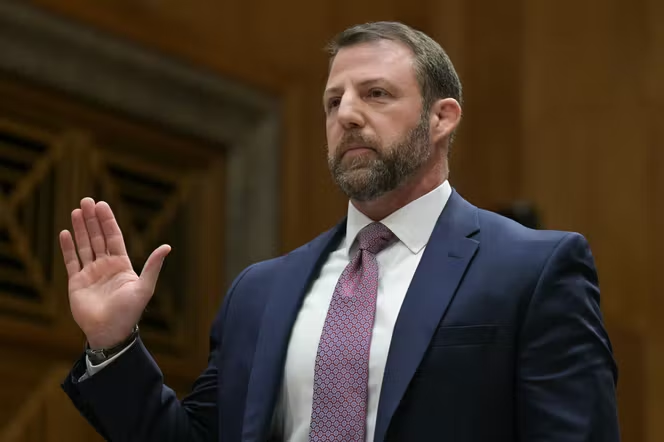
Mullin Homeland Security leadership begins under intense pressure after the Senate confirmed Markwayne Mullin as secretary. The appointment places a close ally of former President Donald Trump at the helm of a department facing political tension, operational strain, and declining public confidence.
The Senate approved Mullin in a 54 to 45 vote. Most Republicans supported the nomination. In addition, two Democrats backed the decision, signaling limited bipartisan support. However, Republican Senator Rand Paul broke ranks and voted against Mullin after a heated confirmation hearing. Meanwhile, Democratic Senators John Fetterman and Martin Heinrich supported the nominee.
As a result, the Mullin Homeland Security transition comes at a critical moment. Public opinion on immigration is shifting. Recent polling shows that Republican dominance on the issue is narrowing. Moreover, concerns about enforcement tactics have increased following fatal incidents involving U.S. citizens earlier this year.
Mullin now faces a difficult balancing act. On one hand, he must rebuild trust in the department. On the other hand, he must deliver on promises of stricter immigration enforcement. These goals often pull in opposite directions, creating a complex policy environment.
At the same time, the department is dealing with operational disruptions. A partial government shutdown has left thousands of employees working without pay. Consequently, airports across the country have experienced long lines and mounting delays. In response, the administration deployed more than 100 immigration agents to assist with airport operations.
The funding crisis stems from a deep political divide in Congress. Lawmakers have failed to agree on a full budget for the Department of Homeland Security. Democrats have pushed for stricter limits on enforcement practices. In contrast, Republicans argue that such restrictions would weaken law enforcement efforts.
Despite the shutdown, immigration enforcement has continued. This is largely due to earlier funding approvals tied to the administration’s broader immigration agenda. Congress allocated more than $170 billion to support enforcement initiatives. Therefore, the Mullin Homeland Security role includes overseeing a significant financial operation.
In addition, Mullin inherits an agency marked by controversy. His predecessor, Kristi Noem, left behind a department facing criticism over enforcement tactics and internal management. As a result, expectations for leadership stability are high.
During his confirmation hearing, Mullin signaled a shift in tone. He emphasized cooperation and adherence to legal standards. For example, he stated that immigration officers would generally avoid entering homes without judicial warrants. This suggests a move toward more restrained enforcement practices.
However, he also reaffirmed his commitment to the administration’s immigration goals. The Mullin Homeland Security agenda still includes large-scale deportation efforts. Therefore, questions remain about how these policies will be implemented in practice.
Some analysts remain cautious. They argue that early promises of moderation may face pressure from political leadership. In particular, the White House continues to support aggressive enforcement strategies. As a result, Mullin may have limited room to shift policy direction.
At the same time, advocacy groups are watching closely. They want to see whether enforcement efforts will focus on public safety rather than broad crackdowns. This distinction could shape how communities respond to federal actions in the coming months.
Supporters of stricter immigration policies see the leadership change as an opportunity. They believe the department can restore confidence in enforcement while addressing recent controversies. In addition, some groups are calling for stronger action against illegal hiring practices, arguing that workplace enforcement is essential.
This presents another challenge for Mullin. Economic priorities often complicate immigration policy. At times, strict enforcement can conflict with labor market needs. Therefore, the Mullin Homeland Security strategy must balance security goals with economic realities.
Looking ahead, Mullin’s success will depend on execution. He must manage a large and complex agency while navigating political pressures. In addition, he must address public concerns about fairness and accountability.
Ultimately, the stakes are high. The Department of Homeland Security plays a central role in national security and immigration policy. As a result, Mullin’s leadership will shape not only enforcement outcomes but also public trust in government institutions.
For now, the confirmation marks the beginning of a demanding chapter. The Mullin Homeland Security era starts with both opportunity and risk, as the department seeks stability in a deeply divided political climate.