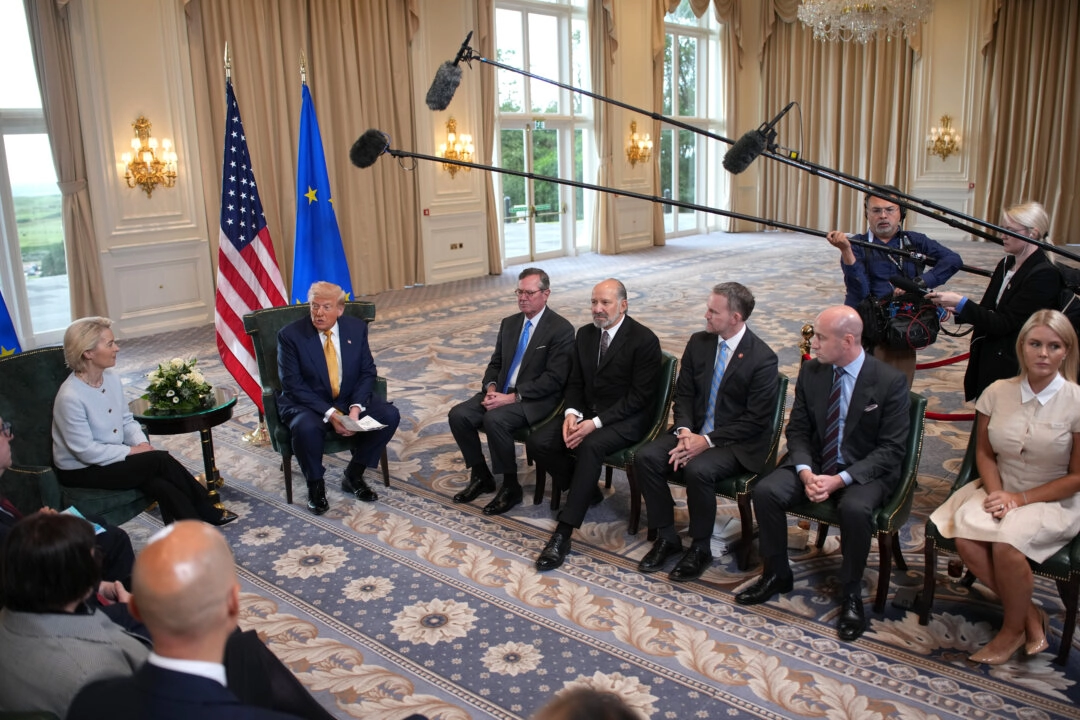
Western European nations find themselves at a significant crossroads, forced to reevaluate their economic and strategic relationships with two global giants: the United States and China. For years, these countries have straddled the line, balancing trade ties with both Washington and Beijing, enjoying the benefits of Chinese manufacturing while relying on the U.S. for defense, technological leadership, and economic influence. However, recent geopolitical shifts—marked by rising U.S. tariffs and China’s growing economic and technological dominance—have made this delicate balancing act increasingly untenable. Europe’s leaders now face a difficult decision: continue absorbing the impact of U.S. tariffs or tolerate China’s strategic manipulation of its market dominance.
US Tariffs vs. China’s Manufacturing Power:
The conflict between U.S. tariffs and China’s manufacturing clout is a critical issue for Europe’s future economic stability. On one side, the United States has imposed tariffs on Chinese imports, seeking to address trade imbalances and security concerns. On the other, Europe is heavily dependent on China’s vast manufacturing capabilities, particularly in crucial sectors like electronics, machinery, and rare-earth elements. These materials are essential for the EU economy and cannot be easily replaced, creating a tough dilemma for European policymakers.
Moreover, the allure of China’s purported “open” market, despite its restrictions and forced technology transfers, remains strong. European companies, eager to tap into China’s massive consumer base, have long participated in joint ventures with Chinese firms, despite the inherent risks. The temptation of a large, profitable market has driven many businesses to accept Beijing’s terms, from unfair competition to intellectual property theft. This strategy, however, has come at a high cost—both economically and in terms of lost technological innovation.
Economic Dependence and Supply Chain Challenges:
Europe’s deep economic ties with China present a fundamental challenge as policymakers attempt to “de-risk” their economies. Despite mounting political pressure to decouple from China, the EU’s dependence on Chinese manufacturing remains substantial. This dependence is especially pronounced in sectors such as electronics, machinery, and, more critically, in the supply chains for advanced technologies, where China plays a dominant role.
At the same time, the impact of U.S. tariffs, coupled with the risk of redirected Chinese exports, has introduced new complications for the EU. If U.S.-China tensions continue to escalate, the Eurozone could become the unintended recipient of redirected Chinese goods, leading to potential trade imbalances and further economic headaches. Europe’s struggle to navigate these competing pressures underscores the difficulty of achieving a balanced, strategic approach in an increasingly polarized global trade environment.
The Illusion of ‘Strategic Autonomy’:
In response to growing concerns over its dependence on both the United States and China, Europe has championed the idea of “strategic autonomy.” The concept suggests that the EU should aim to act independently, building its own defense, energy, and economic capabilities. However, this vision is increasingly seen as unrealistic. Given the interconnectedness of European economies with both superpowers, true autonomy—free from the influence of the U.S. and China—remains a distant ideal.
European leaders have long expressed the desire to reduce the EU’s reliance on external forces, but the reality is that the EU’s economic and industrial base is so deeply intertwined with the U.S. and China that decoupling from either would come at significant economic and political cost. The EU’s involvement in global trade, its financial systems, and technological standards, which are primarily shaped by the U.S. and China, make it nearly impossible to act without considering the interests of both powers.
Industrial Dependence as a Vulnerability:
The vulnerabilities of Europe’s industrial base have been starkly revealed in recent years, especially in light of the COVID-19 pandemic and the ongoing Russia-Ukraine war. Europe’s dependence on Chinese manufacturing for essential goods—ranging from electronics to renewable energy technology—has become a critical issue. The competition with China in these sectors is fierce, and European companies are struggling to keep pace with China’s dominance in pricing, output, and market share.
The war in Ukraine has further exposed Europe’s reliance on external energy supplies, highlighting how geopolitical instability can disrupt vital supply chains. Unlike the United States, which enjoys relative energy independence, Europe is heavily reliant on both Russian and Chinese sources for energy and critical materials. This dependence has left European industries vulnerable to external pressures, exacerbating the need for a more resilient and diversified economic strategy.
The Strains in Transatlantic Relations:
The relationship between the United States and Europe has also come under strain in recent years. The Trump administration’s approach to tariffs, its questioning of NATO’s relevance, and its unpredictability in foreign policy have all contributed to a growing rift between Washington and key European capitals. The U.S. has made it clear that it expects Europe to align more closely with its trade and security policies, but Europe’s growing wariness of unilateral U.S. actions has made cooperation more difficult.
As the U.S. imposes tariffs on China, the fallout for Europe has been unavoidable. EU trade officials are closely monitoring the impacts of these tariffs on European industries, which are often forced to absorb the higher costs of Chinese goods. This has led to increasing calls for fairer trade agreements and for the U.S. to take into account the EU’s interests in the ongoing trade wars.
China as a ‘Systemic Rival’:
In recent years, European sentiment toward China has shifted dramatically. What was once seen as a lucrative market has increasingly become a source of concern. China’s trade practices, including intellectual property theft, market manipulation, and the use of economic leverage for political gain, have led to a growing recognition that China is no longer just a partner in global trade—it is now viewed as a “systemic rival.”
This shift in perception has prompted EU officials to take a more hardened stance against Chinese economic practices. There is growing concern about China’s role in global supply chains, its impact on European industries, and its use of economic power to exert strategic influence. The EU’s decision to label China as a “systemic rival” reflects the reality of an increasingly adversarial relationship, one that challenges Europe’s long-standing economic and geopolitical positioning.
The Future of European Strategy:
As Europe grapples with the complexities of its trade and security relationships with both the U.S. and China, it faces a critical decision. The EU must choose whether to absorb the impact of U.S. tariffs, aligning more closely with American trade policies, or continue tolerating China’s economic dominance, despite the risks posed by unfair competition and intellectual property theft. The choice is not just about trade; it is about Europe’s future geopolitical role and its ability to navigate the complexities of a rapidly changing global landscape.
The stakes are high, and Europe’s leaders must act quickly to ensure that they are not left behind as the world’s two most powerful economies continue to exert their influence. The EU’s ability to manage its relationships with the U.S. and China will determine its strategic autonomy—and its place in the global order—in the years to come.